Pokazywanie postów oznaczonych etykietą Peter Carey. Pokaż wszystkie posty

niedziela, 16 czerwca 2024

Peter Carey, Oskar i Lucynda (Oscar and Lucinda)

Booker z 1988 roku

Oskar i Lucynda to opublikowana w 1988 roku powieść australijskiego pisarza Petera Carey’a, która wygrała Nagrodę Bookera. Autor, obok J. M. Coetzee, Margaret Atwood, Hillary Mantel i J.G. Farrella, otrzymał ją dwukrotnie, drugi raz w 2001 roku za Historię Neda Kelly’ego. Wcześniej sporo słyszałam o książce, więc kiedy wreszcie wpadła w moje ręce, nie zastanawiałam się długo.

Sen o kościele ze szkła

Fabuła jest jednocześnie zwykła i niezwykła, mocno osadzona w realiach XIX wieku, a z drugiej strony baśniowa. Oskar Hopkins, anglikański pastor pochodzący z Devon w Wielkiej Brytanii, poznaje na statku do Australii Lucyndę Lepastrier, młodą dziedziczkę wielkiej fortuny. Młodych ludzi łączą dwie rzeczy – pewne wyobcowanie, niedopasowanie do społeczeństwa, oraz miłość do hazardu. Lucynda inwestuje część swojej fortuny w hutę szkła i zakłada się z Oskarem o dowiezienie szklanego kościoła z Sydney do Bellingen, gdzie stacjonuje znajomy pastor. To projekt na miarę szklanych domów Żeromskiego – zachwycający swym pięknem i idealizmem, ale całkowicie niepraktyczny.

Dychotomie

Akcja rozgrywa się częściowo w starym świecie – Wielkiej Brytanii, a częściowo w nowym – w Australii, mniej więcej w latach 60-tych XIX wieku. To pierwsza dychotomia. Głównym wątkiem jest uczucie rodzące się między dwójką ekscentryków, pełne subtelności, nigdy nieskonsumowane, choć gorszące purytańskich sąsiadów. Jednak w tle możemy obserwować rodzącą się industrializację i fascynację nauką, nadal silną rolę religii i jej wpływu na społeczeństwo, niemal walkę między tymi dwoma ideami.

Malowanie obrazem

Carey potrafi budować niesamowite obrazy – choćby widok szklanej świątyni płynącej po rzece naprawdę pobudza wyobraźnię i jest jakby kwintesencją tej książki. Ale mamy przecież obraz młodego Oskara uciekającego od ojca do sąsiada i przeskakującego przez płot, Lucyndę szwendającą się po hazardowych spelunkach Sydney w poszukiwaniu ukochanej rozrywki, czy choćby obraz statku, z którego trzewi rozlega się wezwanie do karcianej rozgrywki. Te wizje zostają w głowie, chociaż bohaterowie są czasami w swoim zapamiętaniu śmieszni czy niewiarygodni.

Wymagająca lektura

Pozostaję nieprzekonanym czytelnikiem, chociaż książka stanowi już absolutny klasyk. Sądzę, że będę chciała kiedyś do niej wrócić, zobaczyć, co zapamiętałam z tej długiej, czasami nużącej i dość wymagającej lektury. Z pewnością obejrzę też ekranizację w reżyserii Gillian Armstrong, by zobaczyć Ralpha Fiennesa jako Oskara i Cate Blanchett jako Lucyndę. To może być prawdziwa filmowa uczta.

Moja ocena: 6/10.


Peter Carey, Oskar i Lucynda
Wydawnictwo: Prószyński i Spółka, Warszawa 2000
Tłumaczenie: Wacław Sadkowski
Liczba stron: 646
ISBN: 978-83-7255-534-6

********************************************************************************

Booker of 1988

Oscar and Lucinda is a novel by Australian writer Peter Carey, published in 1988 and rewarded same year with the Booker Prize. The author, alongside J. M. Coetzee, Margaret Atwood, Hillary Mantel and J.G. Farrell, has received it twice, the second time in 2001 for True History of the Kelly  Gang. I had heard a lot about the book before, so when I finally got my hands on it, I didn't think twice.

Dream about a church made of glass

The plot is both ordinary and extraordinary, firmly rooted in the 19th century, and on the other hand, fairy-tale-like. Oskar Hopkins, an Anglican minister from Devon, Great Britain, meets Lucinda Lepastrier, a young heiress to a great fortune, on a ship to Australia. Young people have two things in common - a certain alienation, maladjustment to society, and a love for gambling. Lucinda invests part of her fortune in a glasswork factory and makes a bet with Oskar to deliver a glass church from Sydney to Bellingen, where a pastor she knows is stationed. This is a design comparable to Żeromski's glass houses - stunning in its beauty and idealism, but completely impractical.

Dichotomies

The action takes place partly in the old world - Great Britain, and partly in the new world - Australia, approximately in the 1860s. This is the first dichotomy. The main plot is the feeling emerging between two eccentrics, full of subtlety, never consummated, although scandalizing their puritan neighbors. However, in the background we can observe the emerging industrialization and fascination with science, and the still strong role of religion and its influence on society, almost a clash between these two ideas.

Painting with a picture

Carey is able to create amazing images - for example, the sight of a glass temple floating on a river really stimulates the imagination and is the quintessence of this book. But we have the image of young Oskar running away from his father to the neighbor and jumping over the fence, Lucynda wandering around Sydney's gambling dens in search of her favorite entertainment, or even the image of a ship from the bowels of which a call to a card game is heard. These visions stay in the mind, even though the characters are sometimes funny or unbelievable.

A challenging read

I remain an unconvinced reader, even though the book is already an absolute classic. I think I will want to come back to it someday, see what I remember from this long, sometimes tedious and quite demanding reading. I will definitely watch the film adaptation directed by Gillian Armstrong to see Ralph Fiennes as Oscar and Cate Blanchett as Lucinda. This could be a real movie treat.

My rating: 6/10.


Author: Peter Carey
Title: Oscar and Lucinda
Publishing House: Prószyński i Spółka, Warszawa 2000
Translation: Wacław Sadkowski
Number of pages: 646
ISBN: 978-83-7255-534-6

sobota, 15 sierpnia 2020

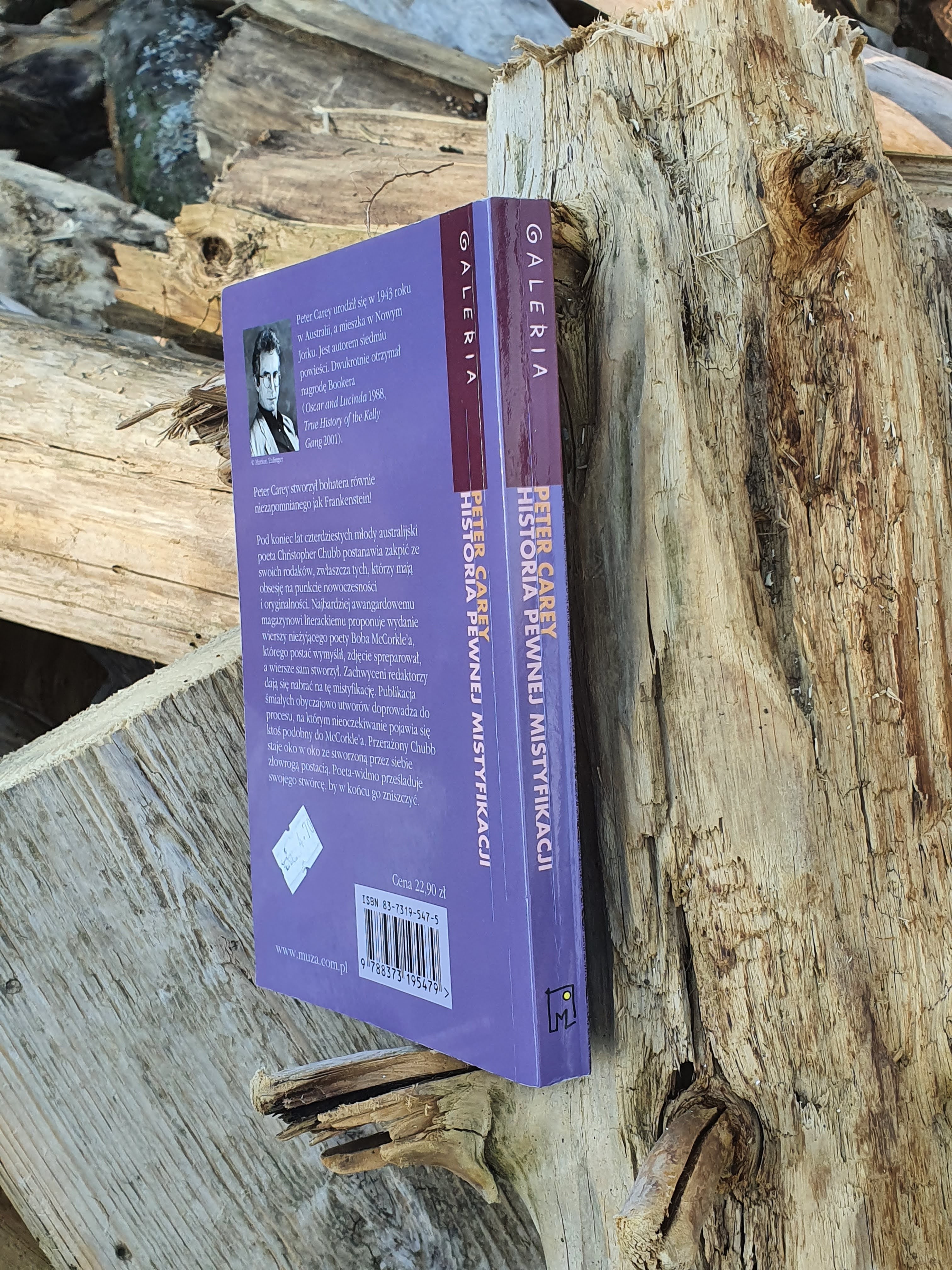
Peter Carey, Historia pewnej mistyfikacji (My Life As a Fake)

Od czasu przeczytania kilku pozycji o minimalizmie, ale przede wszystkim przez moje niekontrolowane nabywanie książek, pozycje, które zdecydowanie mi się nie podobały (ocena 4/10 i niżej) nie zagrzeją u mnie długo miejsca. Tak też będzie z książką, po której sporo sobie obiecywałam, a która mnie bardzo rozczarowała. Mowa o Historii pewnej mistyfikacji Petera Carey’a. 

Zapowiadało się dobrze 


Spośród sześciu książek, które wzięłam na swoje niespełna dwutygodniowe wakacje, ta była na pierwszym miejscu do przeczytania. Nieszczególnie długa (300 stron), nawiązująca do 
Frankensteina Mary Shelley, z ciekawie zarysowaną fabułą – mogła być moim wakacyjnym hitem. Tymczasem historia jest stosunkowo zagmatwana i wielowątkowa, bohaterowie słabo nakreśleni, tło historii tylko utrudnia jej percepcję… Ale po kolei. Redaktorka The Modern Review, Sara Wode-Douglass, wyjeżdża wraz ze znajomym swojej matki, Johnem Slaterem, do Malezji, by poznać historię romansu Slatera ze swoją rodzicielką. Mężczyzna jest podstarzałym poetą, który porzuca nową znajomą w obcym kraju w dniu przyjazdu, i znika. Sara poznaje Christophera Chubba, dziwaka ubranego w łachmany, który jest w posiadaniu ciekawego rękopisu. Kobieta zapoznaje się z jedną stroną wydartą z notatnika i od razu wie, że musi zobaczyć resztę. Okazuje się jednak, by poznać cały rękopis, musi zapoznać się z całą historią życia Chubba, który twierdzi, że napisał ten rękopis sam, a postać autora, Boba McCorkle’a, stworzył. Kiedy inny redaktor, Max Weiss, ma wielkie problemy po opublikowaniu fragmentu utworu ze względu na jego obsceniczność (dzisiaj niczym już nieszokującą), wielkie jest zdziwienie Chubba, kiedy McCorkle pojawia się w sądzie. Dodatkowo, Chubb ma romans z piękną Noisette, która zachodzi w ciążę i rodzi córeczkę. Niezwłocznie postanawia oddać córkę do adopcji, nie konsultując tego z domniemanym ojcem. Chubb zabiera od niej dziecko, ale już tydzień później zostaje ono porwane przez McCorkle’a. Rozpoczyna się trwający wiele lat pościg za zbiegiem, a córeczka Noisette traktuje swojego porywacza jak ojca. Klimat zaczyna nieco przypominać Jądro ciemności Josepha Conrada. Finalnie Chubb odnajduje McCorkle’a i wbija mu zatruty nóż w udo, a potem wraca, by się nim opiekować aż do jego śmierci, licząc, że ta fałszywa troska pozwoli mu odzyskać utracone dziecko. Po drodze przewija się jeszcze nauczyciel-truciciel, walki gangów w dżungli, spławianie tratwą i  duszny klimat Azji. 

Ta książka zabrała mi trzy piękne letnie dni – na szczęście tylko trzy. Wszystkiego było w niej za dużo – wątków sensacyjnych, bohaterów, zwrotów akcji, poetów australijskich i poezji brytyjskiej. Jednocześnie zaś wszystkiego było za mało, postaci nie były psychologicznie pogłębione, tło było naszkicowane niestarannie, brakowało możliwości do wczucia się w klimat Malezji. W przeciągu tych trzech dni zdołałam się naprawdę porządnie zirytować i znudzić. Wielka szkoda, bo Carey ma przecież na swoim koncie obsypane nagroda Oskara i Lucindę oraz Prawdziwa historia Neda Kelly’ego, obie nagrodzone Bookerem, a u mnie na półce czeka Parrot i Olivier w Ameryce. To jeszcze trochę poczeka. Dla mnie nauczka, by sięgać od razu po największe i najważniejsze dzieła danego pisarza, a dopiero potem po te mniej znane, nawet jeśli zabiorą nam tylko trzy dni. Zadziałała chyba magia nazwiska. 


Moja ocena: 3/10


Peter Carey, Historia pewnej mistyfikacji 

Warszawskie Wydawnictwo Literackie MUZA SA 

Warszawa 2005 

Tłumaczenie: Maciej Sadowski  

Liczba stron: 300 

ISBN: 83-7319-547-5 

__________________________________________________________________________________ 


Since reading a few items about minimalism, but most of all because of my uncontrolled purchase of books, items that I definitely did not like (4/10 and lower) will not stay in my place for long. This will also be the case with this very book, which was promising but turned out to be an utter disappointment. I am talking about My Life as a Fake by Peter Carey.

It looked good

Out of the six books I took on my nearly two-week vacation, this one was the first to read. Not particularly long (300 pages), referring to Mary Shelley's Frankenstein, with an interesting plot - it could have been my summer hit. Meanwhile, the story is relatively confusing and multi-threaded, the characters are poorly drawn, the background of the story only makes its perception difficult ... But step by step. The editor of The Modern Review, Sara Wode-Douglass, travels with her mother's friend John Slater to Malaysia to learn about Slater's romance with his mother. The man is an elderly poet who leaves his new acquaintance in a foreign country upon arrival, and disappears. Sara meets Christopher Chubb, a freak wearing rags who has an interesting manuscript. She reads one page ripped from the notebook and knows immediately that she needs to see the rest. It turns out, however, that to know the entire manuscript, he must listen to the entire life story of Chubb, who claims that he wrote the manuscript himself and created its author, Bob McCorkle. While another editor, Max Weiss, has great problems after publishing an excerpt from the manuscript due to its obscenity (no longer shocking today), Chubb's surprise is great when supposedly non-existent McCorkle appears in court. Additionally, Chubb has an affair with the beautiful Noisette, who becomes pregnant and gives birth to a baby girl. She immediately decides to put her daughter up for adoption, without consulting the alleged father. Chubb takes the baby from her, but a week later the infant is kidnapped by McCorkle. The long-lasting chase for the fugitive begins, and Noisette's daughter treats her kidnapper like a father. The climate is beginning to resemble Joseph Conrad's The Heart of Darkness. Eventually, Chubb finds McCorkle and stabs him with the poisoned knife in his thigh, then returns to look after him until his death, hoping that this false concern will allow him to get his lost child back. Along the way, there is also a teacher-poisoner, gang fights in the jungle, rafting and the stuffy atmosphere of Asia.


This book took me three beautiful summer days - luckily only three. There was too much of everything - sensational threads, heroes, twists and turns, Australian poets and British poetry. At the same time, there was not enough of anything, the characters were not psychologically deep, the background was sketched carelessly, there was no possibility to feel the climate of Malaysia. In those three days I managed to get really annoyed and bored. It's a pity, because Carey is an author of Oscar and Lucinda and The True Story of Ned Kelly, both awarded with the Booker Prize, and I have Parrot and Olivier in America waiting on my shelf. After such a poor initial experience, it will have to wait for much longer. For me, the lesson is to reach for the greatest and most important works of a given writer immediately, and only then for the less known ones, even if they only take three days to read. The spell of a known name has worked at the beginning, but failed to last.


My rating: 3/10


Author: Peter Carey

Title: My Life As a Fake

Publishing House: Warszawskie Wydawnictwo Literackie MUZA SA

Warsaw 2005

Translation: Maciej Sadowski

Number of pages: 300

ISBN: 83-7319-547-5